
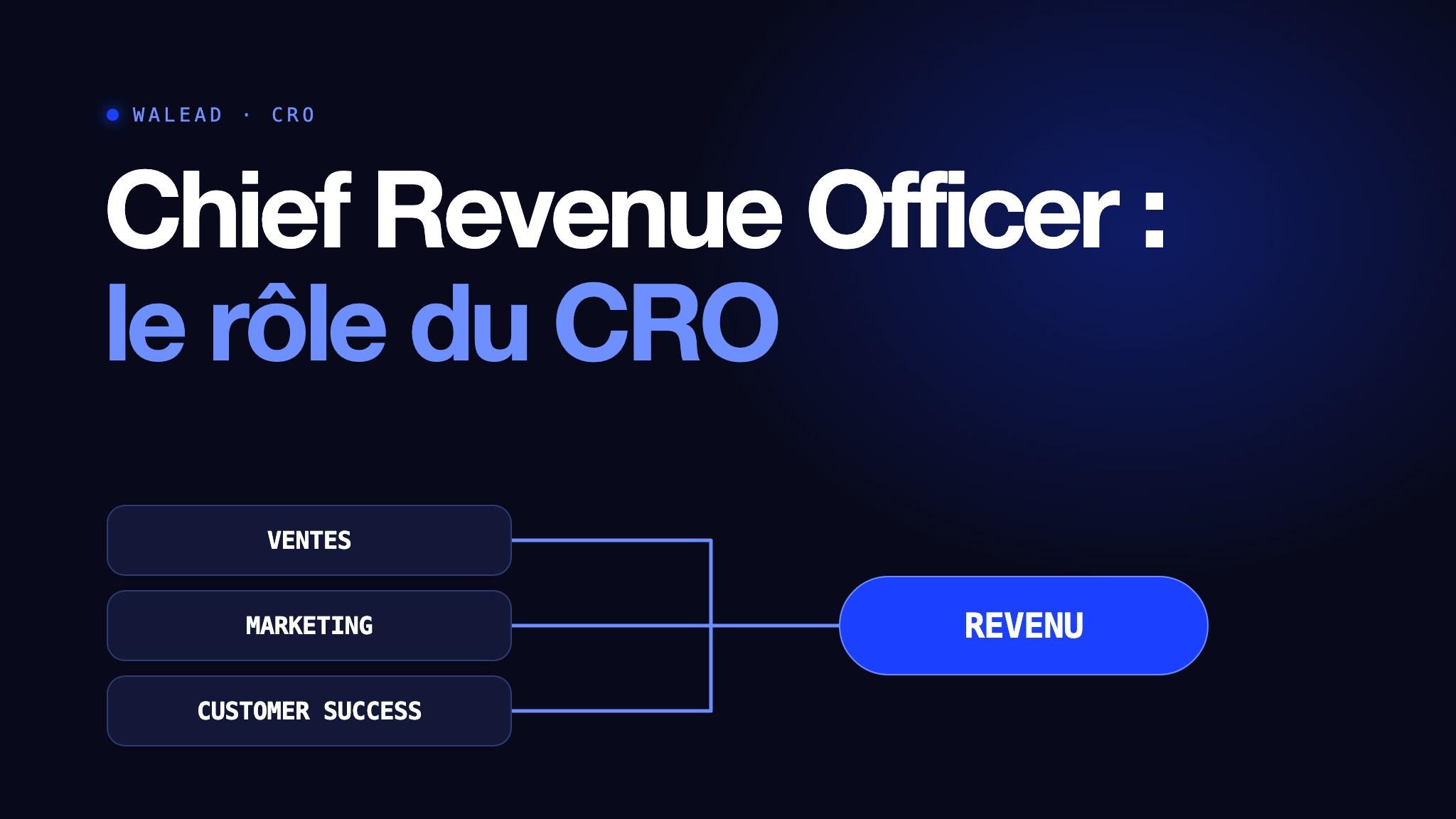
The Chief Revenue Officer (CRO) is the executive responsible for all of a company's revenue: acquiring new customers, growing existing ones and retaining them. They lead sales and, often, marketing, customer success and revenue operations. Where a VP Sales steers selling, the CRO steers everything that produces revenue. The role makes sense when several teams touch the customer and their goals are no longer aligned, usually well after the first VP Sales. Here is the role, the right time to hire one and what sets it apart from a VP Sales.
What is a Chief Revenue Officer?
The CRO is the executive who carries all the revenue. They sit on the leadership team and report to the CEO. Under their responsibility are sales and, depending on the company, all or part of these teams:
marketing, which generates leads;
customer success, which retains customers and grows their contracts;
revenue operations (RevOps), which run the tools, data and processes across the whole chain.
The CRO does not manage salespeople. They manage heads of function, for example a VP Sales, a marketing director and a head of customer success. Their job: move all these teams toward a single revenue goal.
The missions of a CRO
In start-ups and scale-ups, a CRO is generally given five missions:
Set a shared revenue goal. Sales, marketing and customer success work on the same numbers, instead of each having their own targets.
Build and defend the revenue plan. They present the forecasts and their assumptions to the CEO, the board and the investors.
Smooth the customer journey. They organize the handoffs: from marketing to sales, then from sales to customer success. This is often where leads and customers get lost.
Grow revenue from existing customers. Renewals, upgrades, add-on sales: in a growing company, an increasing share of revenue comes from customers already signed.
Hire and grow managers. They structure the organization and hire the head of each team.
Example: a scale-up sees its leads rise, but its sales stall and its customers leave after a year. Marketing blames sales, sales blames the product, and customer success arrives too late. The CRO puts everyone back on the same metrics, from lead generation to renewal.
CRO or VP Sales: what are the differences?
The two roles are often confused. Yet they do not steer the same thing:
The scope. The VP Sales leads the sales team. The CRO leads all the teams that produce revenue.
The metrics. The VP Sales is judged mainly on new sales. The CRO is judged on total revenue: new sales, renewals and growth of existing customers.
The management. The VP Sales manages sales managers. The CRO manages heads of function, sometimes including the VP Sales.
The timing. The VP Sales arrives when selling becomes repeatable. The CRO arrives later, when several teams have to be aligned.
Does a CRO replace the VP Sales? Rarely. Most often, the VP Sales stays in the seat and reports to the CRO, who also coordinates marketing and customer success. The detail of each role is on our job profiles for CRO and VP Sales.
When should you hire a CRO?
The right time comes when the problem is no longer "how do we sell more?" but "how do we get all the teams that touch the customer to work together?" The signs:
Several teams touch the customer and their goals contradict each other: marketing aims for lead volume, sales for quality, customer success for retention.
A significant share of revenue comes from existing customers. Renewals and add-on sales weigh as much as new sales.
You sell across several segments, channels or countries, with different teams to coordinate.
The CEO is constantly arbitrating between marketing, sales and customer success.
In SaaS, a commonly cited benchmark places this moment around $15 to 20 million of annual recurring revenue. Before that, a good VP Sales is generally enough, with marketing and customer success reporting directly to the CEO.
The trap: a CRO too early, or a title too big
Two mistakes come up often:
Hiring a CRO too early. In a start-up with a handful of salespeople, there are not yet several functions to align. The "CRO" then does a VP Sales's job, with a higher package and expectations the company cannot meet.
Giving the title to a profile who has only steered sales. Being a CRO means leading several functions. An excellent VP Sales who has never managed marketing or customer success is not necessarily ready for this role.
Example: a start-up with 5 salespeople hires a "CRO" to attract a senior profile. Six months later, they spend their days doing a Head of Sales's job, and marketing and customer success still report to the CEO. The title changed nothing, except the cost of the hire.
At this level, a mistake shows up late and costs a lot: misaligned teams, unreliable forecasts, several months lost. We have quantified the cost of a failed sales leader hire in our article on the failed Head of Sales hire.
The profile of a good CRO
A good CRO brings together five qualities:
They have already steered several revenue-related functions (sales, marketing, customer success), with numbers they can explain.
They master the forecast and growth metrics: pipeline, conversion rates, retention, acquisition cost.
They know how to hire and grow managers, not just sell.
They are credible in front of a board and can defend a revenue plan and its assumptions.
They know how to align teams with sometimes opposing interests around shared goals.
To compare candidates on these criteria, build a hiring scorecard before the interviews.
How much does a CRO cost?
A CRO's pay depends heavily on the company's stage, the size of their scope and their seniority. That is why we frame it with each client at the briefing. As a benchmark: it is generally above that of a VP Sales, who earns €95k to €230k gross per year, fixed and variable included, according to our placements. It is often accompanied by BSPCE (French equity warrants).
The detail of Head of Sales and VP Sales salaries is in our article on the sales director salary in 2026.
For such a strategic, often confidential role, the exclusive mandate is generally the best fit. At Walead, it costs 20% of annual gross salary, against 22% on success, with a 4-month replacement guarantee in both cases.
Frequently asked questions about the CRO
What is the difference between a CRO and a VP Sales?
The VP Sales leads the sales team and is accountable mainly for new sales. The CRO leads all the teams that produce revenue (sales, often marketing and customer success) and is accountable for total revenue, including retention and growth of existing customers.
When should you hire a CRO?
When several teams touch the customer and their goals are no longer aligned. In SaaS, a commonly cited benchmark places this moment around $15 to 20 million of annual recurring revenue. Before that, a VP Sales is generally enough.
Does a CRO replace the VP Sales?
Rarely. Most often, the VP Sales stays in the seat and reports to the CRO, who also coordinates marketing and customer success.
A CRO to hire? Let's talk
We recruit CROs, VP Sales and Heads of Sales for start-ups and scale-ups. Before launching the search, we check with you whether it is really a CRO you need, or a VP Sales. We present 5 to 10 profiles, with an average time to hire, across all roles, of under 20 days. Book a call: we start from your situation to define the right profile. Also read: Head of Sales or VP Sales: which one to hire first? and Sales director: role, missions, salary and hiring.