
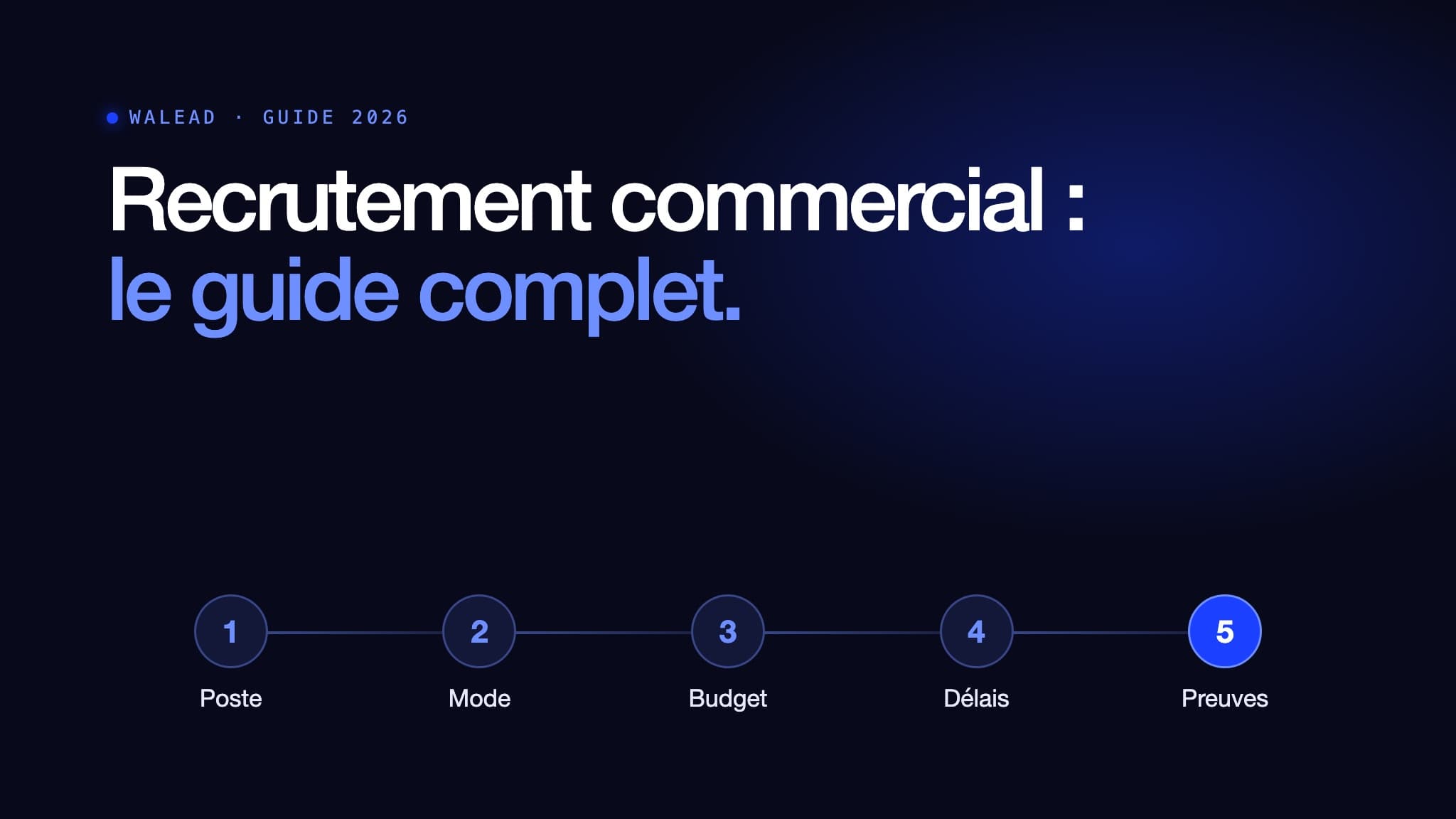
A sales hire is not decided in the first interview, but well before: in the role, the budget and the sourcing. The short answer: five steps, from defining the role to evaluating candidates, and three mistakes to avoid. This guide goes through each step with our 2026 numbers: fees, salaries and timelines. It is written for founders, CEOs and HR leads hiring a Sales profile, from the first SDR to the VP Sales.
Step 1: define the role before you search
Before defining the role, check that the timing is right. Run a 3-week test: every Friday, note what you postponed for lack of time. If prospecting and follow-ups always come after urgent deals, your time is limiting your sales and you need backup. The right moment is when that need exists and your sales method is structured enough to be handed over (see mistake no. 3, below).
The first question is not "who should I hire?" but "to do what?". As long as the role is vague, "a salesperson" means nothing, and you will get candidates who do different jobs. Here are the five Sales roles we hire for in start-ups:
SDR (Sales Development Representative): prospects and books qualified meetings. Does not sign contracts.
Account Executive: runs the meetings, negotiates and signs. The salesperson who carries a revenue target.
Customer Success Manager (CSM): makes already-signed customers succeed, so that they stay and buy more.
Head of Sales: runs the sales team day to day, coaches the salespeople and tracks deals in progress.
VP Sales: sets the sales strategy and leads the managers, when there are several teams or several countries.
Take a classic case: a founder wants "a salesperson who brings in customers". If they already have more meetings than they can handle, they need an Account Executive. If they have no meetings yet, they first need someone who prospects: an SDR, or an Account Executive able to do both.
Before launching the search, also settle these five points, because each one changes the profile to look for:
The target: SMBs, mid-market or large accounts. You do not sell the same way to an SMB owner and to a purchasing committee.
The sales cycle: a few days or several months.
The share of prospecting: does the salesperson find their own meetings, or receive them?
Management: will they manage someone, now or in a year?
Language and country: France only, or a foreign market to open.
Then write the mission of the role in one sentence: what it must produce, and in how long. For example: "open the mid-market segment and sign the first contracts within 6 months". That sentence is the basis for everything that follows: the job ad, the evaluation grid and the interviews. For the detail of each role, see our role pages.
Step 2: agency, freelance or RPO, choose the right hiring model
There are four ways to hire a salesperson: directly, with an agency, through RPO or with a freelancer. The right question is not "which model is cheapest?" but "what is the real pace of my need?".
Hiring directly
It looks free. In reality, you pay in time: the founder's, who sorts CVs and runs interviews instead of selling. It also reaches a limited pool, often just your own network. We come back to this below, in the common mistakes.
The agency, on success or exclusive mandate
The agency searches, filters and presents candidates. At Walead, fees are 22% of gross annual compensation (fixed and variable) on success. On an exclusive mandate, where your role is handled with absolute priority, they are 20%. On success, you only pay if you hire.
Example: for a mid-level Account Executive at €80,000 annual compensation, fixed and variable included, the success fee is €17,600. It is the right model for one or two one-off roles.
RPO, or embedded recruiting
With RPO (Recruitment Process Outsourcing), the recruiter joins your team and your tools. They are paid for time spent, from €600 per day at Walead, rather than a percentage of salary. RPO makes sense when several roles are open at the same time, over several months.
Example: for Ringover, we made 120 hires over 3 years, in 4 countries, from SDR to VP Sales, through RPO. Our article RPO or traditional recruitment agency details the comparison.
The freelance salesperson
A freelance salesperson sells for you without being an employee. It is an option to test a market or a sales channel before opening a permanent role. Walead also places freelance profiles, with a 20% margin.
Whichever model you choose, all our offers include a 4-month replacement guarantee. The detail of each formula is on our pricing page.
Step 3: set the budget, salary and cost of hiring
A hiring budget has two parts: the salesperson's compensation, and what hiring them costs. Start with compensation: it determines which candidates reply.
In Sales, we think in OTE (On Target Earnings): the fixed salary plus the variable pay earned when targets are met. Here is our 2026 grid, in gross annual OTE, drawn from our placements (junior, mid-level, senior):
SDR: junior €36k to €44k, mid-level €44k to €56k, senior €58k to €72k.
Account Executive: junior €50k to €60k, mid-level €70k to €90k, senior €100k to €130k.
Customer Success Manager: junior €35k to €44k, mid-level €46k to €62k, senior €65k to €88k.
Head of Sales: junior €60k to €75k, mid-level €85k to €110k, senior €115k to €145k.
VP Sales: junior €95k to €120k, mid-level €130k to €170k, senior €180k to €230k.
Example: if you offer €55,000 OTE to a mid-level Account Executive, you are below the €70k to €90k range. The profiles you are targeting will rarely reply, or will leave at the first better offer. The detail by role is on our salary page.
For leadership roles, our article on the salary of a sales director details fixed pay, variable pay and what makes compensation vary.
The second element of the budget is often forgotten: the cost of a failed hire. Salary paid, management time, mishandled meetings, a new search to restart: the bill climbs fast, and it shows late. To estimate it for your case, use our bad-hire cost calculator.
Step 4: keep timelines short
An empty sales seat costs something every week: meetings not booked, customers not signed. Timeline therefore matters as much as the choice of profile.
At Walead, we deliver a shortlist in 5 working days, and the hire is made in under 20 days on average. Then count the candidate's notice period if they are employed.
Three things lengthen a hire, and they depend on you, not on the candidates:
A poorly defined role that changes along the way.
Too many interviews, or people unavailable to run them.
A decision that waits a week after the last interview.
Example: a good Account Executive actively looking often has several processes running. If your decision takes two weeks, another employer will have made their offer before you. Our advice: block interview slots from the launch, and set the decision date before seeing the first candidate.
Step 5: source widely, then evaluate on proof
Sourcing: go after those who are not looking
Job ads and networks reach only a small part of the market. Many of the best salespeople are already employed and not looking to leave: they will not apply. So you have to go and find them, through direct approach. And their silence does not mean they are not interested: often, the message did not show them what the opportunity changes for them.
The wider the starting pool, the more demanding you can be at the end. That is the principle we apply: many profiles analyzed at the start, very few presented at the end.
Convincing: give a real reason to move
A good salesperson is comfortable: a built pipeline, their manager's trust, predictable commissions. Changing company means rebuilding everything. A few extra salary points rarely make up for the cost of starting over.
A start-up rarely offers more security than an established company. So it has to offer something else: a wider scope, the chance to build rather than execute, fast progression, or a share of the success (stock options, for example). From the brief, answer two questions: what is the candidate giving up, and what do they concretely gain that they do not have today? If you cannot answer, no outreach message will work.
Evaluating: the scorecard rather than gut feeling
A "good feeling" is the most common justification for a hire, and the least reliable. A scorecard replaces it with the same grid for every candidate: same criteria, same weights, same scores. Our method comes down to five rules:
6 to 8 criteria that say what will make someone succeed or fail in this role.
100 points of weight spread across these criteria, the most predictive ones weighing the most.
Two questions per criterion, and a score from 1 to 5, given only with proof.
Three 30-minute interviews, with the recruiter, the Sales Manager and the Head of Sales, each with their own grid.
A decision rule set before the interviews: 75 points or more, you move forward; 65 to 74, you debate; below 65, you stop.
Example: an Account Executive scores 82, 74 and 71 points across the three interviews. Their average is 75.7: you move forward. The golden rule: if you do not have proof, you do not have a point. Gut feeling is for dessert. A quota attainment rate can be checked in the CRM or a dashboard: ask for proof before believing the numbers.
Our Scorecard page offers a template to download, and our article How to build a Sales hiring scorecard gives the full grids for an SDR and an Account Executive.
Closing: a fast, clear offer
Once you have found the right candidate, do not lose them at the last step. Make a written offer within days of the decision, with the fixed pay, the variable pay, the targets and how the variable is calculated. A salesperson reads the commission plan first: if it is vague, they will hesitate. Before signing, call two former managers and ask them specific questions about their results.
The 3 most common mistakes in sales hiring
These are the three mistakes we see most often among leaders hiring a salesperson. None is a question of budget: they are reflexes, and they can be fixed.
1. Judging a salesperson by the name of their company
"They come from Salesforce, so they are good." The reasoning is tempting, but a large company and a start-up are not the same selling ground. In a large group, the brand opens doors, processes are in place and whole teams support the salesperson. In a start-up, they sell a product nobody knows yet, often without process or support.
An excellent salesperson at a large software vendor may therefore struggle with you. What matters is what they did themselves, in a context close to yours: contract size, sales cycle length, share of prospecting. That is exactly what the scorecard checks.
2. Believing you can hire alone with 10 messages
Many leaders think they can hire themselves by sending 10 or 15 messages around their network. The problem: you do not hire the best salesperson by contacting 10 people. You hire the best of those who replied.
To give an order of magnitude, take Wavo, a Lyon start-up looking for a rare profile. We analyzed 7,000 profiles, contacted 800 people and ran more than 200 interviews to end up with 3 hires. Without going that far, a sales hire needs volume at the start, then a demanding filter. It is full-time work, which a leader's calendar rarely allows.
3. Delegating all selling to the first salesperson
The first salesperson arrives, and the founder stops selling. That is a mistake: the leader must remain the company's number one salesperson. They know the product, the customers and their objections best. And needing help does not mean your sales process is ready to be delegated.
Before hiring, make your selling transferable. Analyze 15 of your sales calls to write a first playbook: your arguments, your questions, the objections and your answers. Your first salesperson should be able to improve this system, not invent it from scratch. The handover then happens in three passes:
You sell, they watch.
They sell, you watch.
They handle ordinary situations alone, and you stay on hand for the rest.
Hiring a salesperson means adding a sales force, not withdrawing from selling.
Frequently asked questions about sales hiring
How long does it take to hire a salesperson?
With Walead, the shortlist arrives in 5 working days and the hire is made in under 20 days on average. Add the candidate's notice period if they are employed. The rest depends on the speed of your interviews and your decision.
Should I hire an SDR or an Account Executive first?
It depends on your volume of meetings. If you already have more than you can handle, hire an Account Executive. Otherwise you first need volume: an SDR, or an Account Executive able to prospect on their own.
What is the difference between a recruitment agency and RPO?
An agency is paid on a successful hire, as a percentage of compensation. With RPO, the recruiter joins your team and is paid for time spent, from €600 per day at Walead. RPO suits situations where several roles are open at the same time, over several months.
A salesperson to hire? Let's talk
A successful sales hire is prepared before the first interview: a clear role, a market-level budget, wide sourcing, a real reason to move and evaluation on proof. The rest is a matter of volume and method. It is our specialty: we hire Sales, commercial and go-to-market profiles for start-ups and scale-ups.
To go further: hiring a salesperson in Dubai or Riyadh if you are opening a market in the Gulf.
To compare our formulas, see our pricing page. And if you have a role to fill, let's talk: book a call, we start from your need to define the right profile.