OTE (On-Target Earnings) is the annual gross pay of a sales rep who hits 100% of their targets: base salary plus variable pay at target. It is the number reps compare between two offers, and the one that tells you where you stand against the market. Here is how it is calculated, how to split it between base and variable, and our 2026 ranges, from Account Executive to VP of Sales, with benchmarks for the CRO.
What is OTE?
OTE adds up two amounts:
The base salary: the guaranteed annual gross pay, paid whatever happens.
The variable at target: what the rep earns by hitting exactly 100% of their targets, as commissions or bonuses.
Example: an experienced Account Executive has a €50,000 base and €30,000 of variable at target. Their OTE is €80,000. At 120% of target, they earn more. At 70%, they earn less.
So OTE is not a guaranteed salary: it is target pay. Equity (BSPCE in France), health cover or meal vouchers are not part of it: present them alongside.
OTE, base and variable: how to read an offer
Faced with an OTE, a good candidate asks three questions:
What is the base? It is the only guaranteed part. A high OTE with a low base shifts the risk onto the rep.
How many reps hit their targets? If nobody does, the advertised OTE is theoretical.
What happens above 100%? Variable pay can rise faster (accelerators) or, on the contrary, be capped.
Prepare your answers before the first interview: the best profiles almost always ask.
How should you split base and variable?
The more directly a role drives signed deals, the bigger the variable share. In our 2026 ranges, variable pay represents roughly:
Account Executive: 30% for a junior, up to 40% for a senior.
Head of Sales: 20 to 30%.
VP of Sales: 25 to 35%.
A manager earns less variable than an Account Executive because they do not control the result alone: their variable often depends on the whole team's targets.
Internationally, variable pay often weighs more: on one of our searches in Saudi Arabia, it made up half of total pay. We cover these differences in our guide to hiring a salesperson in Dubai or Riyadh.
2026 OTE ranges, from Account Executive to CRO
These ranges come from our recent placements (2026 edition). They are annual gross figures: the OTE, then the base and the variable at target.
Account Executive
Junior: OTE of €50k to €60k (base €35k to €40k, variable €15k to €20k).
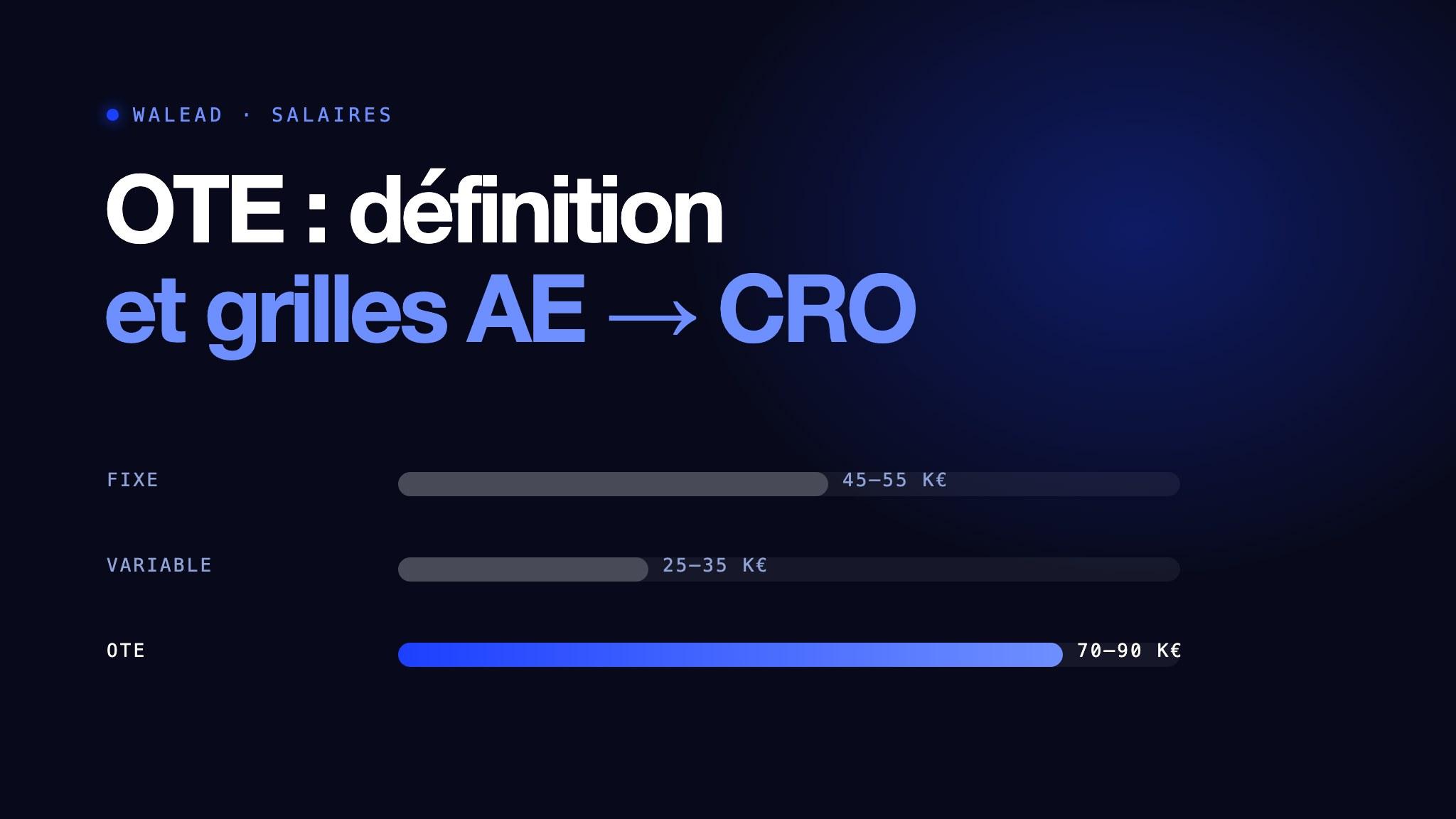
Experienced: OTE of €70k to €90k (base €45k to €55k, variable €25k to €35k).
Senior: OTE of €100k to €130k (base €60k to €75k, variable €40k to €55k).
Head of Sales
Junior: OTE of €60k to €75k (base €48k to €58k, variable €12k to €18k).
Experienced: OTE of €85k to €110k (base €65k to €80k, variable €20k to €30k).
Senior: OTE of €115k to €145k (base €85k to €100k, variable €30k to €45k).
VP of Sales
Junior: OTE of €95k to €120k (base €70k to €85k, variable €25k to €35k).
Experienced: OTE of €130k to €170k (base €90k to €115k, variable €40k to €55k).
Senior: OTE of €180k to €230k (base €120k to €150k, variable €60k to €80k).
Chief Revenue Officer (CRO)
A CRO's pay depends heavily on the company's stage, the scope of the role (sales only, or marketing and customer success too) and seniority. That is why we set it with each client at the brief. Two benchmarks:
it usually sits at the level of a senior VP of Sales or above, i.e. €180k to €230k OTE, and more in scale-ups;
market surveys published in 2025 and 2026 put a CRO's base in France mostly between about €100k and €200k, excluding variable.
At this level, part of the package also comes as equity (BSPCE).
The full grid is on our Sales salaries page. For leadership roles, also read our article on Sales Director salary in 2026.
How to set the quota from the OTE
Variable pay only makes sense if the target is achievable. In SaaS, a common benchmark sets an Account Executive's annual quota at about 4 to 5 times their OTE. For an €80k OTE, that is a target of €320,000 to €400,000 of new revenue signed per year.
That ratio varies with:
deal size: large contracts and long sales cycles justify a higher ratio;
company maturity: with no sales history, set a cautious quota and review it after six months;
the pipeline provided: an Account Executive whose meetings come from an SDR can carry a higher quota than a rep who prospects alone.
Then check the outcome. A good plan lets most of the team hit target. If most reps stay far off, review the quota before replacing them.
Accelerators, caps, ramp-up: the rules of variable pay
Accelerators: above 100% of target, the commission rate goes up, for example by 1.5x. They reward the best and keep them signing.
Caps: capping variable pay reassures the budget but demotivates top performers. For an Account Executive, avoid it.
Payment frequency: monthly or quarterly for an Account Executive, rather quarterly or yearly for a manager or executive.
Ramp-up: a new rep takes several months to sign their first deals. Guaranteeing all or part of their variable during the first months keeps them from leaving before they sign.
What French law says
In France, variable pay is regulated:
When the employer sets targets alone, they must be achievable and communicated to the employee at the start of the period. Otherwise, the employee can claim their variable in court.
In a dispute, the employer must prove that the targets were achievable.
The plan must be written in French (article L1321-6 of the French Labour Code). A commission plan written only in English may be held unenforceable against the employee.
In practice, put everything in writing (targets, calculation, accelerators, payment dates) and have your legal counsel review the plan before presenting it to the team.
4 common OTE mistakes
Advertising an OTE nobody reaches. Candidates check it in interviews, and the team knows.
Too little variable for an Account Executive. With 10% variable, they have little reason to sign more.
Changing the plan every quarter. The team loses trust and spends its time recalculating commissions.
An overly complex plan. A rep should be able to work out on their own what they will earn.
A good OTE attracts candidates, but it is not enough to pick the right one. To compare profiles on objective criteria, build a Sales hiring scorecard.
OTE FAQ
What does OTE mean?
OTE stands for On-Target Earnings. It is the annual gross pay of a sales rep who hits 100% of their targets: base plus variable.
Is OTE guaranteed?
No. Only the base is guaranteed. Variable pay depends on results: above 100% of target, the rep earns more than their OTE; below, they earn less.
How much variable for an Account Executive?
According to our 2026 placements, variable pay is about 30% of a junior Account Executive's OTE and up to 40% for a senior. An experienced Account Executive, for example, has an OTE of €70k to €90k, of which €25k to €35k is variable.
Setting the right OTE: let's talk
We recruit Account Executives, Heads of Sales, VPs of Sales and CROs for start-ups and scale-ups. Before launching the search, we help you set pay at market level, to attract the right profiles without overpaying. We present 5 to 10 profiles, with an average time to hire under 20 days. Discover our services. And if you would like to talk it through, book a call: we start from your situation.