A good sales compensation plan fits on one page: a fixed salary, a variable part calculated on a simple indicator (most often new annual recurring revenue, or ARR, signed), a realistic target, a commission rate and accelerators above 100% of target. The rest (threshold, cap, clawback, payment date) must be written down before the period starts. Here is how to build it step by step in a B2B start-up, and the rules to respect in France.
If you are first looking for salary ranges by role, read our article OTE: definition and pay ranges from AE to CRO. Here, we talk about the mechanics of variable pay.
The 7 elements of a sales compensation plan
The calculation base. What the variable is calculated on. Common choice in B2B start-ups: the new annual recurring revenue (ARR) signed.
The variable share. The weight of variable pay in the package. Common choice in B2B start-ups: about 35 to 40% for an Account Executive.
The target (the quota). The amount to sign over the period. Common choice in B2B start-ups: 4 to 5 times the pay at target.
The commission rate. What each euro signed earns. Common choice in B2B start-ups: the target variable divided by the target.
The accelerators. The rate applied above 100%. Common choice in B2B start-ups: 1.5 to 2 times the base rate.
The threshold and the cap. From when the variable kicks in, and up to where. Common choice in B2B start-ups: a threshold, but no cap.
The payment rules. When the commission is earned and paid. Common choice in B2B start-ups: at the customer's first payment, every month or every quarter.
1. Choose the calculation base
Variable pay must rest on an indicator the salesperson controls and that you can measure without argument. The four most used bases:
Signed revenue: simple and motivating, but you also pay commissions on customers who will never pay.
Recurring revenue (ARR or MRR): the natural base for a SaaS vendor, because it reflects the value of the subscriptions signed.
Margin: useful if prices are heavily negotiated or if you also sell services. It avoids excessive discounts.
Cash collected: the safest base for your cash flow, but the salesperson waits longer for their commission.
For an Account Executive, keep a single main indicator. Beyond two or three criteria, nobody knows what really counts.
2. Set the variable share by role
The closer the role is to signing, the more variable pay weighs. Here are the shares seen in our 2026 grid, at experienced level, at target:
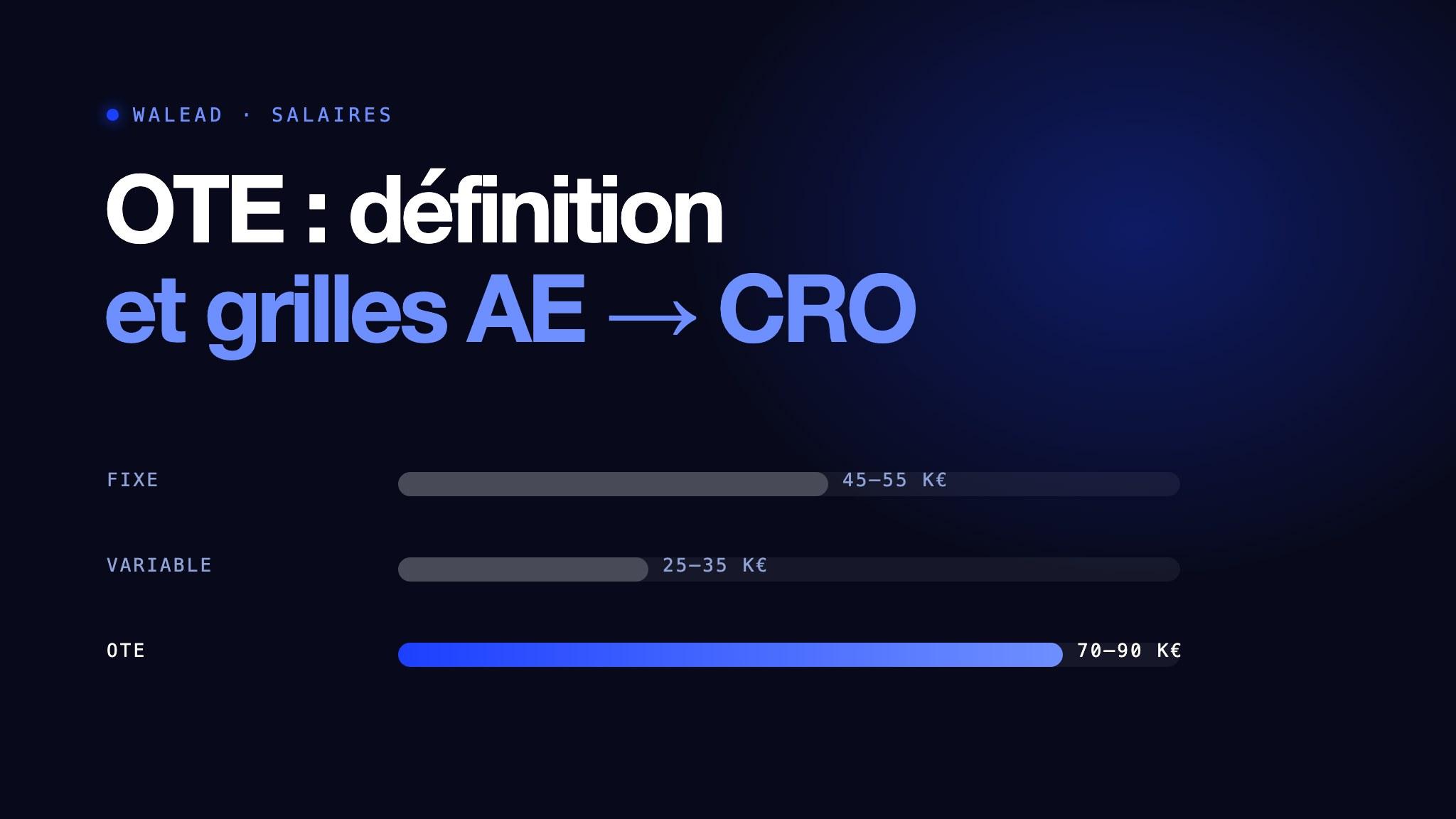
Account Executive : fixed €45k to €55k, variable at target €25k to €35k, that is about 35 to 40% variable.
Head of Sales : fixed €65k to €80k, variable at target €20k to €30k, that is about 25% variable.
VP Sales : fixed €90k to €115k, variable at target €40k to €55k, that is about 30% variable.
Source: Walead 2026 Sales salary grid, gross per year, France.
A manager has a lower variable share than an Account Executive, because their job is not limited to their own signatures: hiring, coaching, making forecasts reliable. Their variable generally relies on the whole team's result.
3. Set the target and the commission rate
A first benchmark links the target to the pay aimed for. A common benchmark: an annual target equal to 4 to 5 times the pay at target (the OTE). In the United States, this ratio is 4.6 at the median for an Account Executive in 2026, according to the 2026 study by the American consulting firm The Bridge Group, covering 158 B2B companies.
The commission rate is then simply calculated: the target variable divided by the target.
An example with an experienced Account Executive:
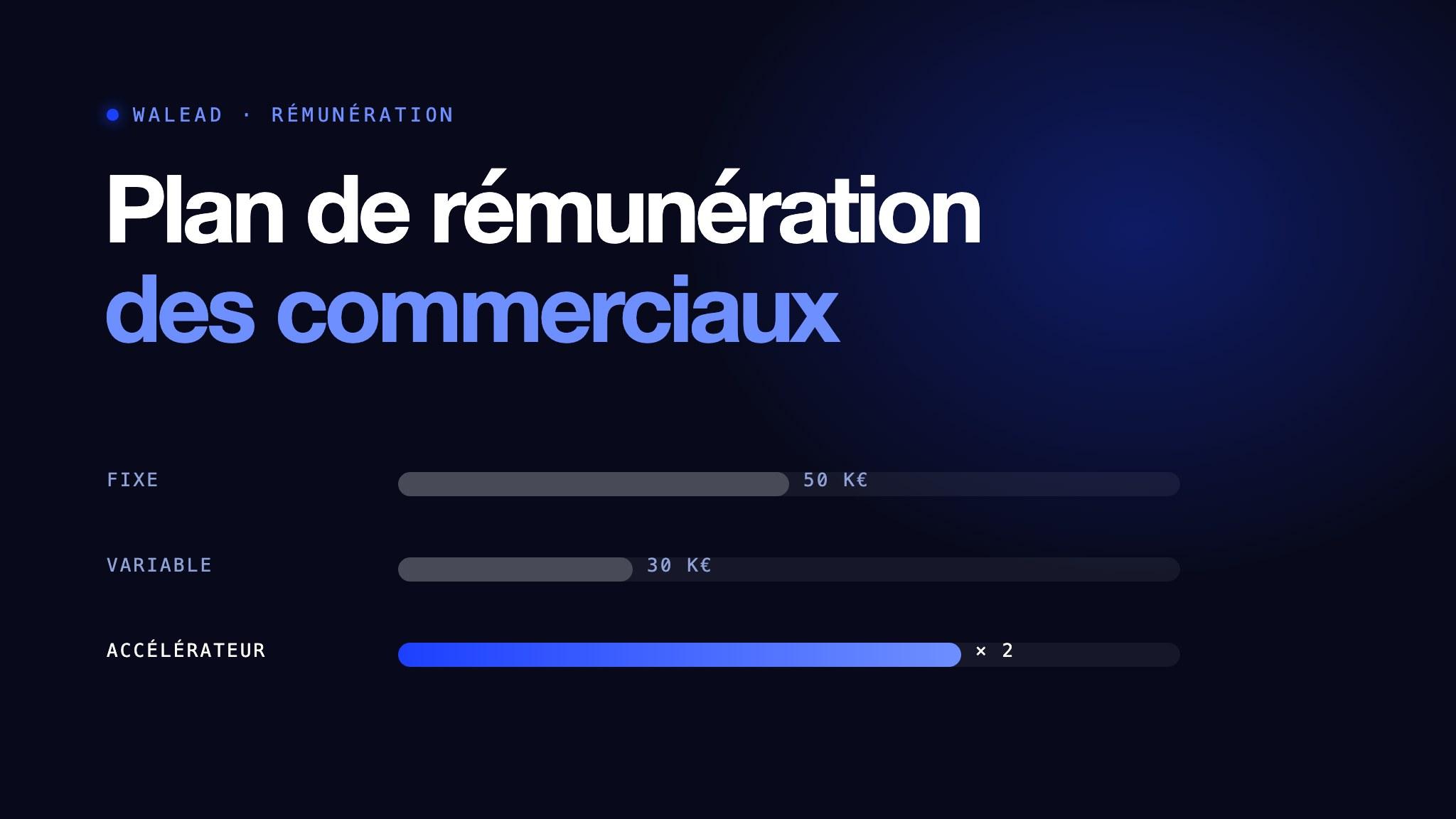
Fixed: €50,000. Variable at target: €30,000. Pay at target: €80,000.
Annual target: 4.5 × €80,000 = €360,000 of new ARR.
Commission rate: €30,000 ÷ €360,000 = 8.3%. Each €10,000 ARR contract earns the salesperson about €833.
Then check that the target is achievable: look at what your current salespeople sign, the length of your sales cycle and the number of meetings that marketing and SDRs can provide. For a new hire, plan a reduced target during the first months, while they learn the product and build their pipeline.
4. Add accelerators and a threshold
Accelerators reward salespeople who exceed their target: above 100%, the commission rate increases. Common multipliers range from 1.5 to 2 times the base rate.
Back to the example. The salesperson signs €432,000, that is 120% of their target, with an accelerator of 2 above 100%:
Up to €360,000: €30,000 of variable.
Above: €72,000 at the doubled rate (2 × 8.33% = 16.67%), that is €12,000.
Total variable: €42,000. Pay for the year: €92,000.
The threshold sets the level below which the variable does not kick in, or kicks in at a reduced rate (this is then called a decelerator). It avoids paying a full commission for a year far below expectations.
The cap, for its part, is to be avoided. A salesperson who knows they will earn nothing more above a certain level pushes their signatures to the next period. If you fear an exceptional contract, plan a rule for very large contracts, written in advance, rather than a general cap.
5. Write the payment rules
Disputes rarely come from the rate. They come from cases that had not been foreseen. Write down in black and white:
When the commission is earned: at signature, at go-live or at the customer's first payment.
The case of a customer who cancels or does not pay: clawing back a commission already paid is delicate under French law. Many companies therefore prefer to trigger it at the customer's first payment, provided it is written in the plan.
The payment frequency: every month or every quarter for an Account Executive. An annual variable is too far from the effort to motivate.
The case of departure: what happens to the contracts signed before the salesperson leaves. Have this clause validated by a lawyer.
One-off bonuses (the "SPIFFs", for Sales Performance Incentive Fund): a short bonus to push a new product or a quarter end. Keep them simple and time-limited.
What French law says
In France, variable pay is regulated. Four rules to know:
The calculation method written in the employment contract is an element of the contract. The employer cannot change it without the employee's agreement, even if the new calculation is more favorable to the employee.
The targets set by the employer must be achievable and communicated at the start of the period. This is the Court of Cassation's constant position (Cass. soc., March 2, 2011, no. 08-44.977). If the employer does not set the targets, the variable is owed in full (Cass. soc., June 7, 2023, no. 21-23.232). Targets set late can have the same effect.
Targets must be written in French (article L. 1321-6 of the Labor Code). Targets written only in English may be held unenforceable against the employee, with exceptions (documents received from abroad, for example).
In a dispute, it is for the employer to produce the calculation elements it holds. Keep the figures that justify each commission paid.
This information is not legal advice. Have your plan reviewed by a lawyer or labor law attorney before signing it.
Mistakes to avoid
Multiplying criteria: beyond two or three, the salesperson no longer knows what to focus on.
Setting targets late, or changing them during the year: this is a frequent source of disputes, and the variable may then be owed in full.
Capping the variable: the best salespeople push back their signatures, or leave.
Paying at signature with no rule for non-payment: you pay commissions on contracts that will never be collected.
Leaving the plan verbal, or in a simple message: the plan must be a written, dated document, in French, handed to the salesperson at the start of the period against signature.
Copying a large company's plan: a start-up needs a simple plan, which the founder can explain in five minutes.
Frequently asked questions about sales compensation plans
What variable share for a salesperson?
For an experienced Account Executive, variable pay generally represents 35 to 40% of pay at target, according to our 2026 grid. It is lower for a Head of Sales (about 25%) and for a VP Sales (about 30%), whose variable relies mostly on the team's result.
How do I calculate a salesperson's commission rate?
Divide the target variable by the annual target. An Account Executive with €30,000 of variable and a target of €360,000 of new ARR has a rate of 8.3%: each €10,000 ARR contract earns them about €833.
Can the employer change the variable plan during the year?
Not freely. If the calculation method is set in the contract, the employee's agreement is needed. If targets are set every year by the employer, they must be achievable and communicated at the start of the period: changing them during the year exposes you to a dispute.
Setting the right package for your salespeople: let's talk
We recruit Sales profiles from Account Executive to CRO, for start-ups and scale-ups. Before each search, we help you set a package at market level: fixed, variable and plan rules. Our Sales Salaries page gives the ranges for fixed, variable and OTE of our roles, from Account Executive to VP Sales, drawn from our placements. We present a shortlist within 5 days, for a full hire within 20 days on average, with a 4-month replacement guarantee. Discover our offers and fees. And if you want to talk about it, book a call: we start from your situation.